
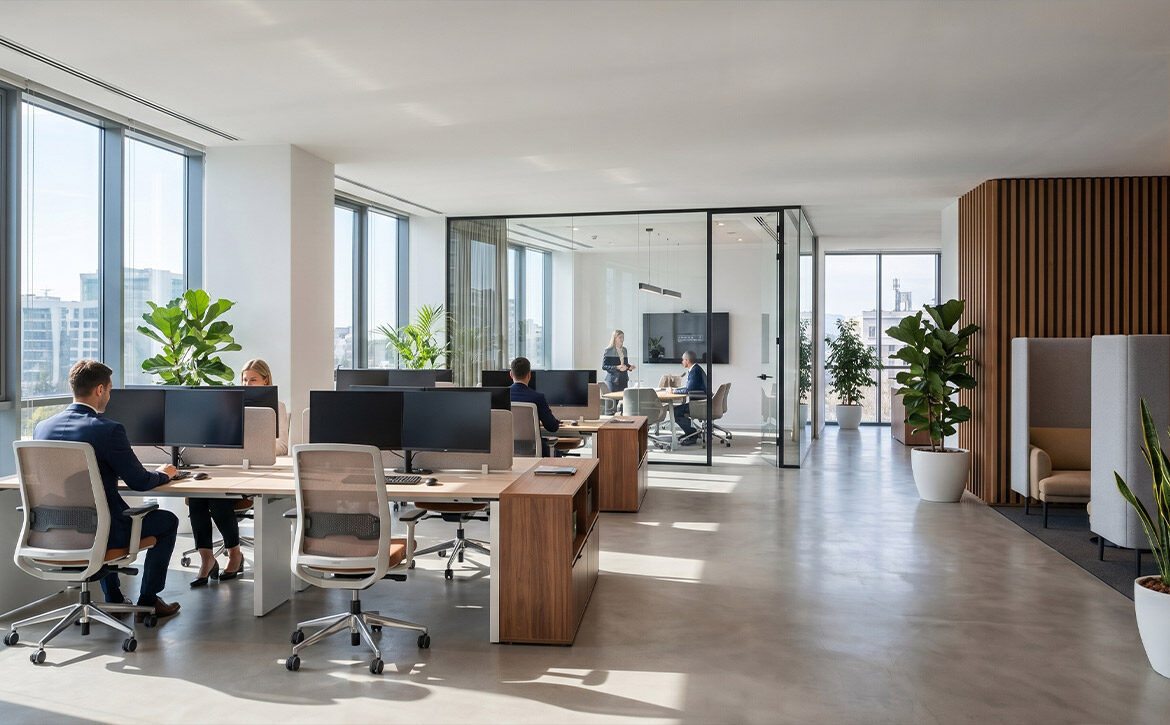
Open Space Offices – Benefits and Space Planning
Open space offices are increasingly chosen as a solution for companies that want a more dynamic, flexible and connected working environment. Instead of the traditional division into closed offices, this concept places emphasis on an open space, easier communication and better everyday collaboration among employees.
In the rest of the text, we explain what open space offices are, what types of such spaces exist and what to pay attention to when planning and designing them.
What Are Open Space Offices?
Open space offices are workspaces in which employees work in a shared, open environment, without the traditional division into a large number of closed offices.
Work desks are most often arranged in a way that makes communication, quick agreements and everyday collaboration easier for teams.
This concept is particularly suitable for companies in which tasks often overlap and teams need to exchange information quickly. That is why it is often chosen by creative, IT, consulting, sales and development teams, as well as by larger companies that want more open internal communication.
However, a modern open space does not mean that everything takes place in one large room. A good business space combines open work zones with meeting rooms, spaces for private conversations, quiet work and informal breaks.
Why Do Companies Choose Open Space Offices?
Companies most often opt for an open office layout because this type of space makes everyday work easier and enables teams to stay better connected. Its main advantages are:
- Easier collaboration – employees exchange information faster, ask questions more easily and reach shared solutions more simply.
- Fewer formal meetings – short agreements can be made immediately, without scheduling separate meetings for every minor decision.
- Greater spatial flexibility – an open layout can be more easily adapted to team growth, new projects or changes in work organisation.
- Stronger sense of community – when employees are not physically separated, it is easier to develop a team atmosphere and gain better insight into what colleagues are working on.
- Faster response to changes – teams can align more easily when new priorities, client requests or urgent tasks arise.
However, open space on its own does not guarantee better teamwork. To truly function, the space needs to be well organised, with clear rules for use and the possibility for employees to choose where they will work depending on the task.
Types of Open Space Office Concepts
The benefits of the open space concept are most visible when the space is adapted to the team’s way of working. That is why it is important to understand that there is not just one model of an open office, but several different approaches to organising space.
1. Fully Open Workspace
This is the simplest form of an open space office. Work desks are located in one larger open zone, without many physical partitions. This layout can suit teams that have a similar work rhythm and collaborate often throughout the day.
The advantage of this model is simple communication and good visibility across the space. However, it is important to pay attention to noise, desk layout and enough space between workstations, so the office does not become tiring for everyday work.
2. Zoned Open Space
Zoned open space means an open area divided according to function. One part can be intended for teamwork, another for quieter individual work, a third for quick meetings and a fourth for informal conversations or breaks.
This model is practical because it preserves openness, while introducing more order into the everyday use of space. Employees know where certain activities take place, making it easier to balance collaboration and concentration.
3. Hybrid Open Space
Hybrid open space combines open work zones with closed offices, meeting rooms and smaller focus spaces. This is often the most functional solution for companies that want open communication, but do not want to lose privacy and quiet when they are needed.
This model can be a good choice for management teams, companies that work with clients or organisations that combine creative, analytical and administrative tas
4. Flexible Space with Changeable Workstations
In this concept, workstations are not necessarily permanently assigned to the same employees. Teams can use the space in line with daily tasks, projects or office attendance schedules.
This model is especially suitable for companies that combine office work and remote work. However, for it to function properly, it requires a good organisational system, enough space for storing personal items and clear rules for using shared zones.
What Are the Most Common Challenges of Open Space Offices?
Although these offices can make collaboration and everyday communication easier, an open space can also bring certain challenges if it is not well planned. Most often, attention should be paid to:
- Noise – conversations, phone calls, impromptu meetings and constant movement through the space can distract employees during work.
- Lack of privacy – an open layout is not always suitable for confidential conversations, important calls or tasks that require discretion.
- Unclear organisation of zones – if it is not clear where meetings take place, where conversations are held and where quiet work is expected, an open space can quickly become disorganised.
- Too much movement through the space – poorly positioned walkways and desks can disturb employees who are trying to concentrate.
These challenges are most easily solved through good space organisation, clear zoning and rules that help employees use an open space in the right way.
What Should You Consider When Designing an Open Space Office?
When planning an open office concept, the most important starting point is the team’s way of working. The space should not be designed only according to how it looks, but according to how it will be used every day.
Special attention should be paid to:
- The team’s way of working – if employees collaborate often, open zones should support the quick exchange of ideas. If most of the work requires concentration, quieter parts of the space should be planned.
- Acoustics – noise is one of the most common challenges in open space offices, so it is necessary to consider furniture layout, the distance between zones and spaces for conversations.
- Meeting and call rooms – separate spaces for meetings, video calls and private conversations help keep the open part of the office more pleasant for work.
- Lighting – natural light, well-positioned work desks and quality lighting can make the space more pleasant and less tiring during the day.
- Ergonomics – chairs, desks, monitors and the layout of equipment directly affect employee comfort and the functionality of the space.
- Movement through the space – walkways should be logical, work zones clear and meeting areas easy to access, so employees’ work is not disrupted.
- Impression on clients and partners – an office often says a great deal about an organisation, its culture and its level of professionalism.
A well-designed open space should be open, but not chaotic. Its function is to make collaboration easier while also giving employees enough comfort and focus for everyday work.
Why Is the Business Environment Important for a Good Open Space?
An open space office does not depend only on the interior. The building it is located in, location, access, technical infrastructure and amenities that make employees’ everyday routines easier are also important.
Companies choosing office space are not only looking for square metres, but for an environment in which the team can work steadily, professionally and long term. That is why a good location, easy access, parking, security, reception, air conditioning and supporting amenities are an important part of the overall work experience.
When an office is located in a business environment that supports the team’s everyday rhythm, it is easier to organise meetings, business visits and collaboration with clients, partners or institutions. Good connectivity and a recognisable address affect not only the practicality of the working day, but also the professional impression a company leaves.
When flexible office space is combined with quality infrastructure and the amenities of the complex, an open space office becomes much more than a modern desk layout. In such an environment, The Capital Plaza provides a framework in which work, meetings and everyday business obligations can take place more simply and in a more organised way.
You can read more about the location, amenities and advantages of the business space in the article why choose an office in The Capital Plaza.
Open Space Offices as Support for Modern Ways of Working
The value of open space offices is not only that they remove physical barriers, but that they adapt the space to modern ways of working.
For such a concept to truly function, it is necessary to carefully plan the layout, acoustics, focus zones, meeting spaces and everyday movement through the office. When this is combined with a quality location, good infrastructure and amenities that make the working day easier, this type of office becomes much more than an interior design solution.
It becomes a space that follows the team’s rhythm, supports the company culture and helps the business develop in an organised, professional environment.